A vertical platform lift carries a person using a wheelchair or scooter straight up and down between two levels. It uses an open platform and a drive mechanism, which is why people often describe it as a mini elevator. Installation is where the general description stops being useful, because an indoor lift inside a home, an outdoor lift beside a porch, and a commercial lift in a public building each raise different questions.
Here is what changes across those three settings, what a site survey actually looks at, and the details worth settling before anyone orders equipment.
What a vertical platform lift does
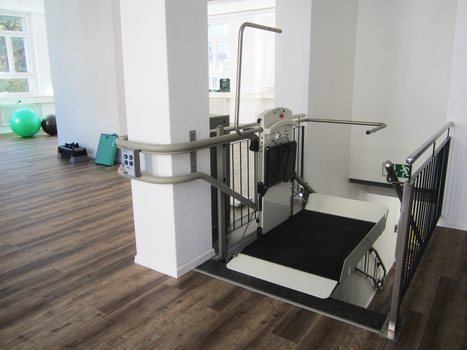
A vertical platform lift, also called a wheelchair lift, is a mechanical device that moves a person and their mobility equipment vertically between levels. The basic design is an open platform attached to a drive mechanism. The platform travels straight up and down, and the rider rolls on at one level and off at the other.
Because the travel is vertical rather than along a staircase, a platform lift takes up minimal floor space compared with a long ramp. Some compact designs reach up to 14 feet, and manufacturers often describe vertical lifts as the type that most closely resembles an elevator. The resemblance is real but limited. A platform lift is an open platform machine, not an enclosed passenger elevator.
The core use case is simple. For someone who cannot manage stairs or a long slope, a lift converts an unusable level change into a short ride. That holds true in a house, a clinic, a school, or a community building.
Indoor vertical platform lift installation
Indoor installations usually happen inside a home, a garage, or a building interior where the lift connects two finished levels. The work is less about weather protection and more about the space around the platform.
Travel height between the two landings, since that sets the equipment class.
Clear floor space where the rider boards and where they exit, including room to turn a wheelchair.
Where the platform rests when it is not in use, and whether that spot blocks a doorway, hallway, or parked car.
How the rider calls the platform, operates it, and gets help if something stops working.
Whether the upper landing needs a gate or barrier.
Indoor lifts are also judged on finish, noise, and how well the equipment fits the room. A lift in a finished basement stairwell is a different job from a lift in an unfinished garage, even when both travel the same distance.

Outdoor vertical platform lift installation
Outdoor lifts solve level changes at porches, decks, entries, and grade changes where a ramp would be too long or simply not available. The equipment is the same basic idea, but the site does more of the deciding.
Surface and support at both landings, since the platform has to meet a stable, level approach.
Water management around the base, so standing water does not sit where the platform lands.
Weather exposure and how the platform, controls, and gates are protected between uses.
Clearance along the travel path and for anyone walking past the unit.
Access for service visits, which matters more when the lift sits away from the house.
Outdoor lifts are common in residential settings, and they also appear where a building entrance needs an accessible route. An installer who works outdoors regularly will flag drainage, approach slope, and clearance during the survey rather than after the equipment arrives.
Setting | What the lift usually solves | Planning focus |
|---|---|---|
Indoor residential | Level change inside a home or garage | Floor space, boarding clearance, upper landing gate, finish |
Outdoor residential | Porch, deck, or grade change at an entry | Stable approach, drainage, weather exposure, service access |
Commercial and public | Accessible route in a building used by staff and visitors | Traffic volume, code review, controls, service records |
Commercial and public building options
Commercial lifts carry more traffic and more scrutiny than a home unit. They serve schools, transit facilities, hospitals, senior living communities, and other public buildings where an accessible route has to work every day, for people who have never seen the equipment before.
What changes on a commercial project:
Usage. A lift used by dozens of people a day needs a service rhythm, not a repair-when-broken approach.
Controls and instructions. Riders are first-time users, so call buttons, labels, and platform gates need to be obvious.
Site coordination. Installation often touches entries, corridors, or exterior walkways that other people use during the work.
Documentation. Facilities teams typically want a service contact, a maintenance plan, and a record of what was installed.
We also run ADA compliance audits and wheelchair lift operational safety training for organizations, which often sit alongside a lift purchase rather than months after it. Confirming the exact code requirements for your building with your local authority is part of the project, and it is the step that settles many layout questions.

What the installation process looks like
The equipment is only one part of the job. A lift that works well is the result of a survey that matched the machine to the site.
Survey. A technician measures travel height, landing dimensions, approach space, and the route the rider takes to reach the platform.
Site review. Indoor, outdoor, and commercial sites get different checks: clearances inside, drainage and exposure outside, traffic and code review in a public building.
Equipment selection. Travel height, platform size, gate and control configuration, and finish are matched to the survey. As an authorized dealer for more than 40 manufacturers, we are not limited to one product line.
Installation and handover. Our technicians are company employees and mobile, and we install in 32 states, so the crew that surveys is part of the same organization that installs. At handover, the rider or facility contact learns the controls, the gate sequence, and who to call.
Service. Lifts need adjustment and periodic attention, especially outdoor and high-traffic commercial units. Rental options exist for short-term needs.
Prices depend on travel height, configuration, and site work, so a credible number comes after a survey rather than before. Anyone quoting a firm figure without seeing the site is guessing.
Choosing between a lift, a ramp, and a stairlift
These three options solve related problems in different ways.
A ramp converts the level change into a sloped path, and it works well where there is room for a long, gentle run.
A stairlift follows a staircase, carrying a seated rider up and down the steps.
A vertical platform lift moves straight up and down on a platform, takes minimal space, and lets a rider stay in their wheelchair or scooter.
The deciding factors are usually space, whether the rider stays in their mobility device, and how often the route is used. A home with a short rise and a tight footprint points one way. A public entrance with steady traffic points another.
Questions to settle before you schedule a survey
What is the travel height between the two levels?
Who will use the lift, and will they be in a wheelchair, a scooter, or on foot?
Is the installation indoors, outdoors, or in a building open to the public?
Does the upper landing need a gate or barrier?
Who will service the lift, and how quickly can a technician reach the site?
What does your local authority require before the lift can be used?
Answering those questions before the survey makes the visit shorter and the quote more accurate. It also reduces the chance that a site detail, such as a doorway that is too narrow or a landing that slopes, forces a redesign after equipment is ordered.
Frequently Asked Questions
How high can a vertical platform lift travel?
Some compact vertical platform lift designs reach up to 14 feet of travel, and manufacturers publish a maximum for each model. The right figure for your building depends on the model, the landing layout, and local requirements. A site survey confirms the travel height you actually have and matches equipment to it.
Is a vertical platform lift the same as an elevator?
No. A vertical platform lift uses an open platform and a drive mechanism, and it moves straight up and down. It is often described as a mini elevator because the motion feels similar, and vertical lifts are the type that most closely resemble an elevator. An enclosed passenger elevator is a different category of equipment with different requirements.
Can a vertical platform lift be installed outdoors?
Yes. Outdoor vertical platform lifts are used at porches, decks, and building entrances where a ramp is impractical. The site matters more outdoors, so the survey looks at the approach surface, drainage around the base, weather exposure, and access for service visits. Gates and controls are chosen with outdoor use in mind.
Does a vertical platform lift work for scooters?
Yes. Vertical platform lifts are designed to transport people in wheelchairs or scooters vertically between levels. Platform size and capacity vary by model, so tell your installer which mobility device will be used most often. That detail affects platform dimensions, gate layout, and the boarding space needed at each landing.
How much does a vertical platform lift cost?
There is no single answer, because price depends on travel height, platform size, gate and control configuration, indoor or outdoor placement, and the site work involved. A survey is the only reliable way to get a real number for your building. Ask for a written scope that lists equipment, installation, and service separately.