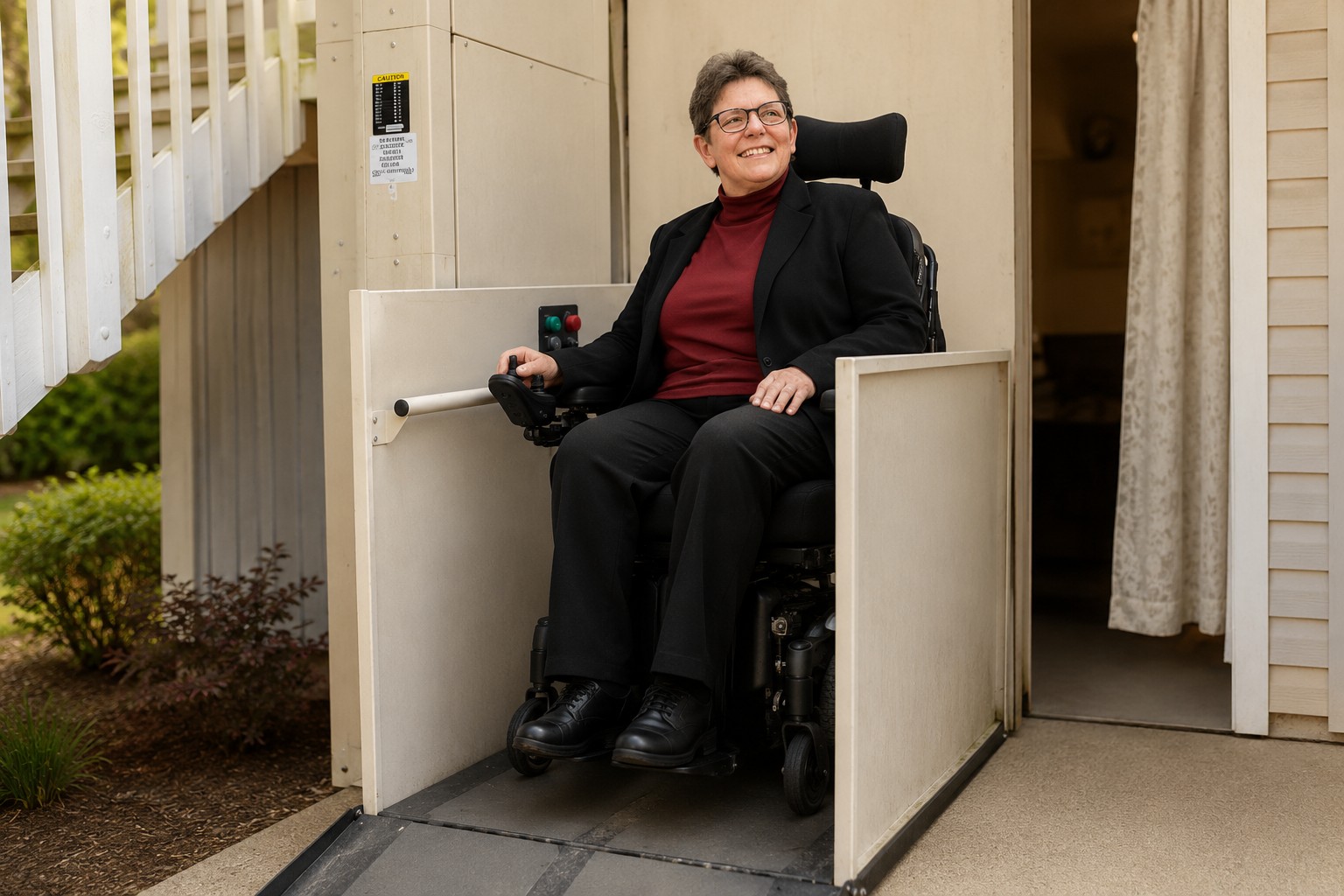
Residential VPLs
Porch, deck, and garage entrances where the rise is too great for a ramp to be practical or safe.

Free Consultation | Estimate
A mobility specialist will contact you shortly. All consultations, estimates, and scopes of work are provided completely free of charge. No pressure or obligation.
Answer a few questions about the rise and the entrance and see the platform lift we would recommend, with its price, installation included.
What each one is for, and who it suits.
Porch, deck, and garage entrances where the rise is too great for a ramp to be practical or safe.
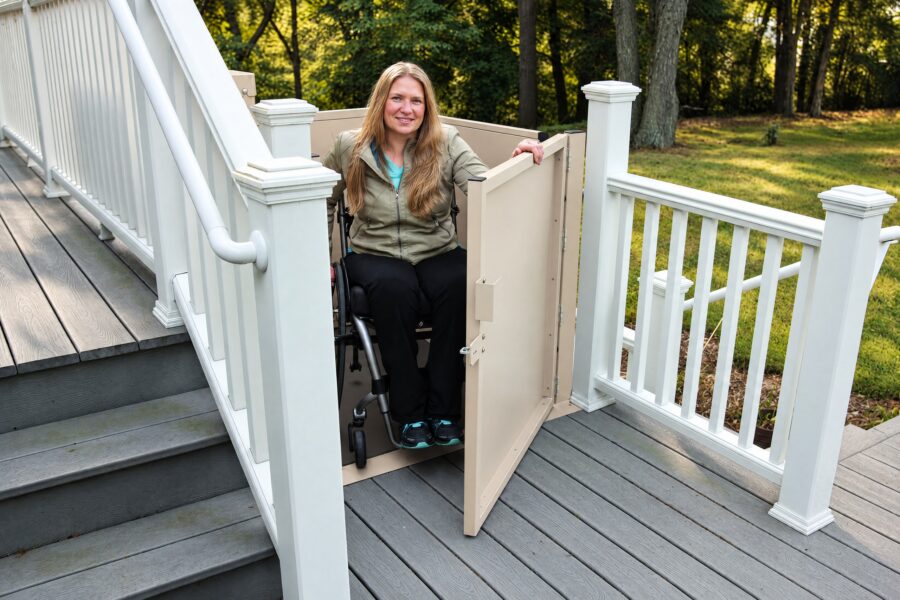
Platform lifts for business entrances, specified and installed to the applicable code and inspection requirements.
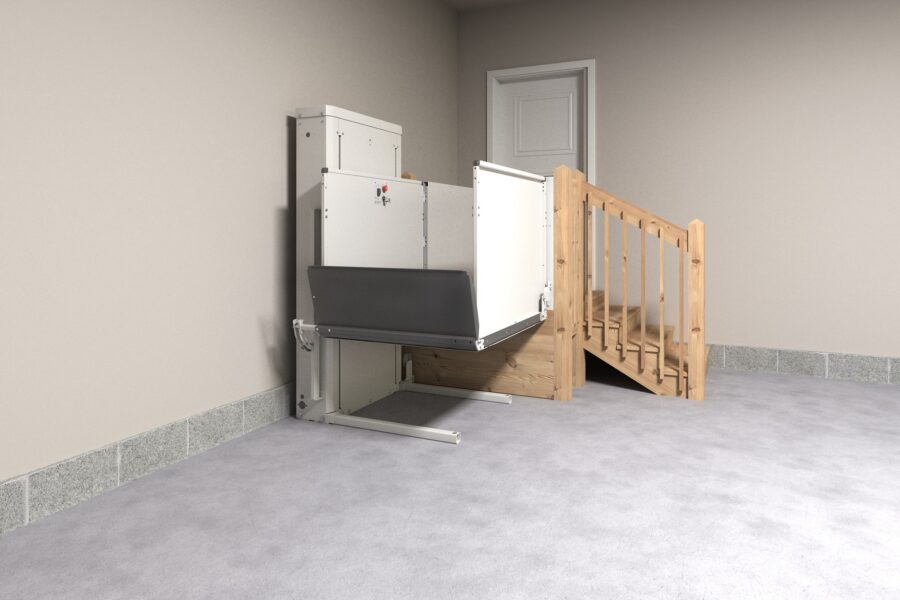
Weather-rated units for exterior installation, with the enclosures and drainage an outdoor lift needs.
Point at one to see what it carries and what it is for. Every one of these we sell, install, and service ourselves.
Bruno · Vertical platform lift
Straight up, with the wheelchair still under you.
Harmar · Vertical platform lift
A platform lift for a porch, a deck, or a garage.
Four questions, in this order. The answers narrow it quickly, and most of them are about the site rather than the person.
A porch is a few feet. A split level or a raised entrance can be twelve. Travel height decides the model, whether a shaft or enclosure is required, and in many places whether the job needs a permit and an inspection.
Short rise: unenclosed, simpler permit Taller rise: enclosure and inspectionOutdoor lifts are built for weather: sealed controls, drainage, corrosion protection, and a cover. An indoor unit put outside fails within a season, and we will not install one that way.
Indoor: standard finish and controls Outdoor: weather-rated throughoutA platform lift needs a level, load-bearing pad. Sometimes that exists already. Sometimes a slab has to be poured and cured before we can install, which is the part that adds weeks rather than days.
Existing slab: measured and checked New pad: poured, cured, then installedA residential lift and a commercial one are different machines under different codes. In a public building the lift has to meet ADA and elevator code, and in most states the installer has to hold a license to touch it.
Residential: home code, home equipment Commercial: ADA, elevator code, licensed installWe do not publish a figure, because it depends on the rise and the site. These are the things that actually change it, in rough order of impact.
Travel height
The single biggest factor. Taller rises need more structure, sometimes an enclosure, and often a permit.
Site preparation
A concrete pad, a power run, or drainage. This is where a job gets longer as well as more expensive.
Indoor or outdoor
Weather-rated components cost more and are not optional outside.
Residential or commercial
Commercial equipment, code compliance, and licensed installation are a different tier entirely.
Enclosure and gates
A hoistway enclosure, upper landing gate, and interlocks, where the rise or the code requires them.
Permitting and inspection
Varies by state and municipality. We handle it, but it is real time and real cost.
The bars show relative impact, not dollars. For a real number, the survey is free.
Most people comparing a platform lift are really deciding between it, a long ramp, and moving the entrance.
A platform lift
CostThousands
TimeWeeks
Takes a wheelchair and its occupant straight up. Small footprint, and it works in rain and in winter.
A ramp
CostLess, usually
TimeDays
Cheaper and quicker where there is room. Code slope means roughly a foot of ramp for every inch of rise, which most front yards cannot give.
Moving the entrance
CostTens of thousands
TimeMonths
Occasionally the right answer on a difficult site. Rarely the cheap one, and it is construction rather than equipment.
Doing nothing
CostNothing up front
TimeImmediate
Means somebody is carried up the steps, or does not leave the house. Both have a cost that does not show up on a quote.
Six parts, and the ones that decide reliability are not the ones people ask about.
Sized to take a wheelchair and its occupant with room to turn. Non-slip surface, and side guards that stop a caster running off.
Screw, hydraulic, or chain. It decides how smooth the ride is, how loud it is, and what maintenance looks like in year five.
Lower and upper landing gates with interlocks, so the lift cannot move while a gate is open and a gate cannot open mid-travel.
Constant-pressure controls on the platform plus calls at each landing, so the lift can be brought to whoever needs it.
Keeps the lift running through a power cut and lowers it safely if it cannot. Nobody is left on a platform.
The least glamorous part and the one that decides whether the machine stays level and safe for twenty years.
Four things we hear on nearly every platform lift call.
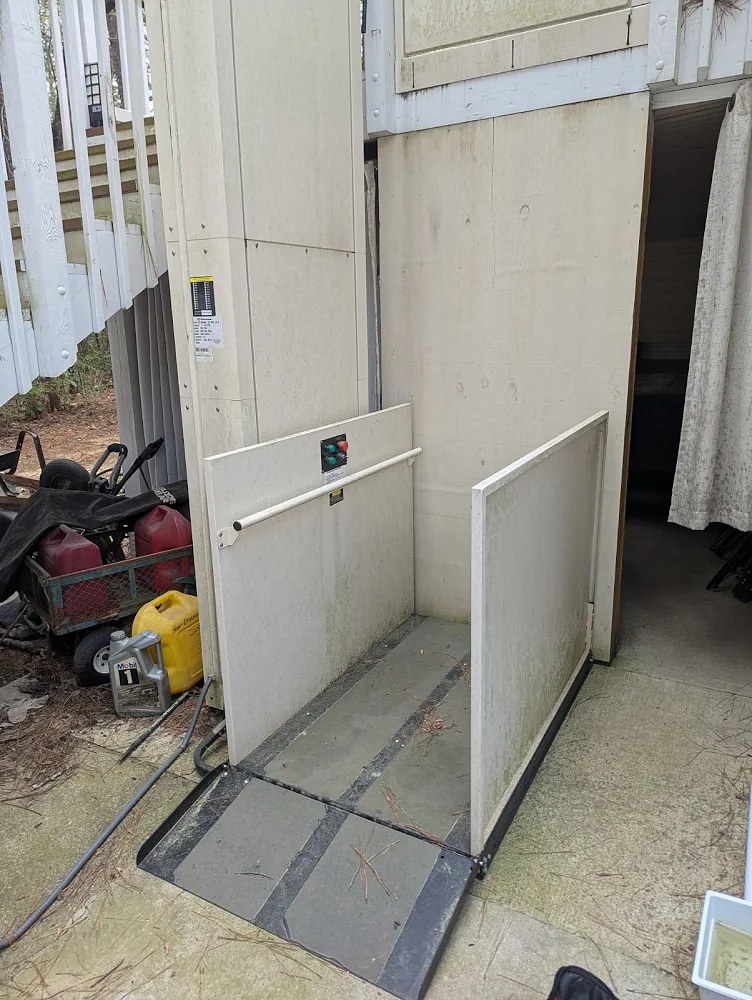
Photographed on the day, in real homes and buildings.
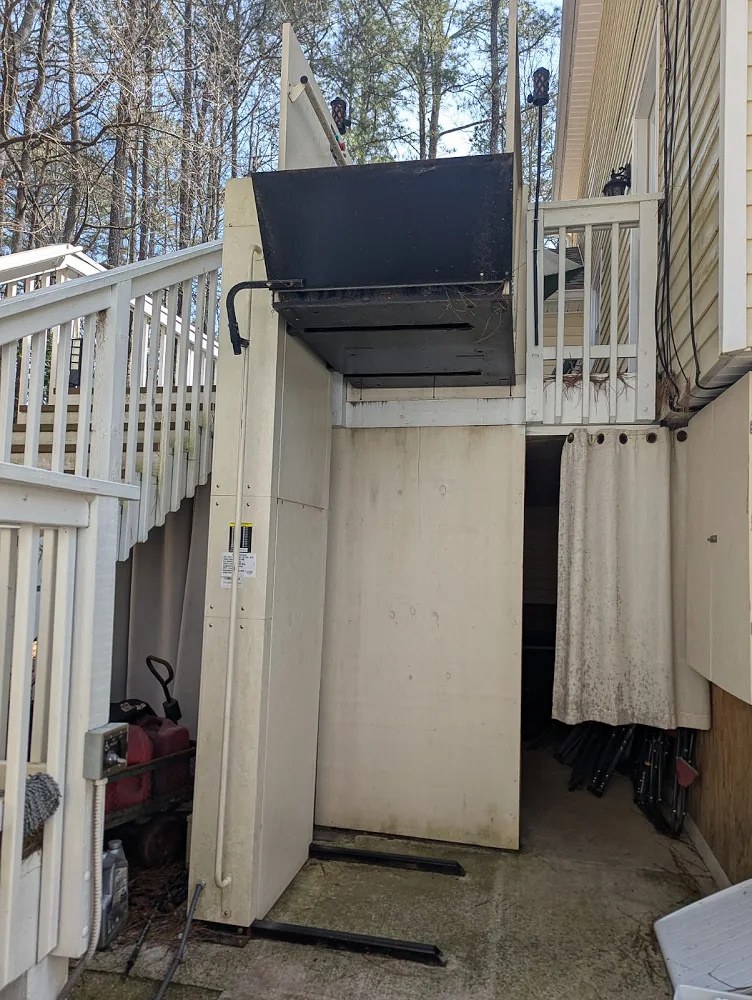
Carrying several lines means the equipment gets matched to the situation rather than the situation getting matched to the equipment.
A conversation about the person, the building or the fleet, and the budget. Free, and with no obligation to buy anything.
A technician surveys the site in person and gives you a written scope, so the price you agree to is the price of the job.
Factory-certified technicians install and commission the equipment, and stay until everyone who has to operate it can.
Maintenance and repair for as long as you own the equipment, from the people who put it in. Scheduled preventive maintenance where a contract calls for it.
Anybody can sell equipment. Installing it legally, configuring it clinically, and servicing it afterward takes credentials that have to be earned and kept current. Here is what our team holds.
Licensed elevator mechanics, state by state. Residential elevators and platform lifts are regulated work in most jurisdictions, and this is the license that makes it legal to do.
RESNA-recognized credential for evaluating a person's needs and specifying the assistive technology that fits. This is who you want configuring a power chair or a seating system.
The credential for supplying individually configured complex rehab. It is what separates a supplier who works alongside your clinical team from one who ships a box.
Training in modifying a home so someone can stay in it. It is the difference between installing equipment and understanding the house it goes into.
Industry service certification covering installation, maintenance, and repair standards across mobility equipment.
Federal certification for handling refrigerant in vehicle air conditioning. It is required to legally service a bus AC system, and it is why fleet work is something we can actually take on.
What Our Customers Say
Pulled directly from our verified Google reviews. We respond to every single one.
Customer reviews on Google
Mason is a wonderful service technician! We live in “rural country” of NE Georgia and he drove all this way to get my Dad’s chair lift up and running. Thank you, Mason AND Custom Mobility!
As a fellow business owner, I have seen this company do all of their work with as much professionalism and tact as any that I have ever encountered. I thoroughly enjoy actually witnessing people who care about their work and show it through their actions, and the owner at Customer Mobility is the ep…
My Service Technician is truly the best! He responded within a day and he fixed the chairlift in less than an hour! It’s reassuring to know that we can depend upon Custom Mobility!
Far less than a ramp. ADA guidance calls for twelve inches of ramp run for every inch of rise, so a thirty inch porch wants a thirty foot ramp. Most front yards cannot give that up. A platform lift needs roughly the footprint of the platform itself.
Yes. The platform is flat with a gate at each end, so you walk or roll straight on. Many of our residential platform lifts are used by people who are unsteady on steps rather than by chair users.
Some configurations do and some do not. The site survey settles it before you are quoted.
The units run on batteries and include a manual lowering method, so nobody is stranded on the platform.
Commercial installations are, and requirements vary by state. We handle the permitting and the inspection.
Yes. In most states this equipment requires a licensed installer and an inspection, and we hold that licensing in our own name rather than borrowing it from a subcontractor.
Yes, with weather-rated equipment: sealed controls, drainage, and a cover. We will not install an indoor unit outside, because it fails within a season.
Weeks rather than days, and most of that is site preparation and permitting rather than the installation itself. If a concrete pad has to be poured and cured, that is the long pole.
A free survey, a written scope, and a number that does not move afterward.