Grab bar installation cost usually lands between $100 and $350 for one bar, including the bar and the labor to mount it. That range covers a straightforward bathroom job and reflects the two main pieces of the bill: materials at roughly $20 to $150 per bar and labor at about $50 to $150 per hour. A single bar often takes 20 minutes to an hour, so the final number depends on the wall, the bar, and the market.
Published estimates show how wide the spread can be. A Texas pricing guide puts professional installation, including the bar, at $100 to $300 per grab bar. Seattle cost data lists a safety grab bar installed at $175 to $361 each. Those figures are useful benchmarks, not a quote for your bathroom. The only reliable price comes from someone who has seen the wall and knows how many bars you want.
What the total grab bar installation cost includes
The installed price is not just the bar. It combines the hardware, the labor to place and secure it, and the time needed to handle the wall surface. Published ranges break down the main components clearly, which makes it easier to read a contractor quote and see what is missing.
| Cost component | Typical range | What affects it |
|---|---|---|
| Grab bar materials | $20 to $150 per bar | Bar length, finish, style, and mounting hardware |
| Labor rate | $50 to $150 per hour | Installer, market, minimum visit charge, and job complexity |
| Time per bar | 20 minutes to 1 hour | Wall condition, surface material, and access to mounting points |
| Total installed cost | $100 to $350 per bar | Location, number of bars, wall preparation, and local pricing |
Materials alone run $20 to $150 per bar. The rest is labor. Most installers charge $50 to $150 an hour and spend 20 minutes to an hour per bar, with longer jobs when the wall needs extra work. That labor share explains why a $40 bar does not turn into a $40 installed project.
Why grab bar installation cost varies by location
The room matters because the mounting surface and the surrounding space change the work. A bar beside a toilet is a different job from a bar inside a shower or along a tub wall. Published estimates repeatedly tie the total to location, and local pricing guides show meaningful regional differences.
In Texas, a 2025 pricing guide places professional installation including the bar at $100 to $300 per bar. Seattle cost data puts a safety grab bar installation at $175 to $361 each. A Bellevue, Washington guide for 2026 breaks out materials at $20 to $150 per bar and labor at $50 to $150 an hour, with jobs often taking 20 minutes to an hour. Broader estimates put the total at $100 to $350 per bar. These are not contradictions. They reflect different markets, different jobs, and different assumptions about the bar itself.
Shower and tub areas can take more care because the wall may be tiled or finished in a way that needs protected work. A simple bar on an accessible wall may move quickly. A bar that requires extra preparation can take longer, and that time shows up in the labor line. Ask the installer to price the exact wall, not a generic bathroom.

Where grab bars belong in a home
Grab bars are most often discussed for the bathroom, but the useful question is where a person actually needs support. Common locations families ask about include the shower, the tub, the toilet area, and paths where someone turns or rises. The exact placement should fit the person using the space, not a one-size-fits-all diagram.
In a shower, a bar can give a handhold while stepping in, standing, or turning. Around a tub, the need may be support while sitting down or rising. Near the toilet, a bar can help with lowering and standing. Outside the bathroom, entries and hallways may be worth reviewing if balance is a concern. The right layout depends on the user’s height, reach, mobility, and the way the room is used.
Placement also has to respect the wall. A bar is only as good as its attachment, and the installer needs to know what is behind the surface before choosing the mounting method. That is why a careful installation starts with an assessment rather than a guess. If a family member is unsure where a bar should go, an installer who works with bathroom safety equipment can review the room and suggest practical positions.
What pushes a quote above the basic range
A basic per-bar range does not cover every job. Several factors can move the number, and most of them are visible before installation starts. Knowing them helps you compare quotes on equal terms.
- Number of bars: published ranges are usually quoted per bar, so a three-bar bathroom has three material and labor components.
- Wall condition: extra preparation can add time, and time is billed.
- Surface material: tile and finished walls may need more careful handling than a plain surface.
- Bar choice: materials run $20 to $150 per bar, so a premium bar raises the total.
- Travel and minimum charges: a small job may carry a visit minimum that is not obvious in an hourly rate.
- Local market: the same job can fall at different points in the $100 to $350 range from one city to another.
A quote of $200 to $400 per bar is also within the range reported in consumer discussions, especially for more involved work or higher-cost areas. That does not mean every job at that price is overpriced. It means the quote should explain what is included. A bare labor price and an all-in installed price are not the same thing.

How to compare grab bar installation quotes
Ask for a quote that separates the bar, the mounting hardware, and the labor. Confirm how many bars are covered and whether the price is per bar or for the visit. If the installer charges by the hour, ask for the estimated time and the minimum charge. These details make it much easier to compare two numbers that look similar on the surface.
It also helps to describe the room accurately. Mention the surface, the number of bars, and whether any wall work is expected. A quote based on a photo or a short description is still an estimate. The installer may need to inspect the wall before confirming the price. Get the scope in writing so the final bill matches the agreed work.
Published cost data is a starting point, not a substitute for a local quote. The $100 to $350 total range, the $20 to $150 material range, and the $50 to $150 hourly labor range all come from broad estimates. Your bathroom may fall inside those numbers or outside them. The value of the estimate is that it tells you what questions to ask.
DIY materials versus professional installation
The gap between a bar and an installed bar is mostly labor. Materials alone cost $20 to $150 per bar, while professional installation commonly brings the total to $100 to $350. That difference pays for the installer’s time, knowledge of mounting, and responsibility for the finished job.
Some homeowners may choose to install a bar themselves, but the wall assessment is the part that should not be skipped. A bar that is not securely attached can fail when someone puts weight on it. If there is any doubt about the wall or the mounting method, professional installation is the safer way to handle the project. The cost of a call is easier to plan for than a failed bar.
How My Mobility Center handles grab bar projects
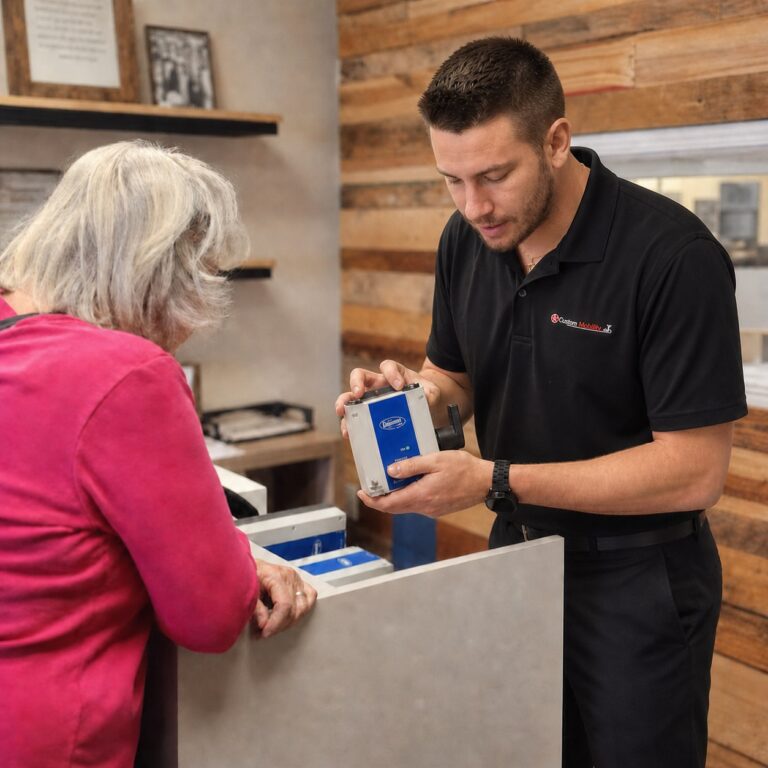
My Mobility Center installs grab bars and bathroom safety products using company-employed mobile technicians. The company has done accessibility work since 1990, is family-owned, and serves customers in 32 states. A project can be as small as one bar or as broad as a bathroom safety review, and the goal is a practical setup that fits the person and the room.
Because the technicians are mobile, the assessment and installation can be handled by the same team. That matters for grab bars, where the right position and the right mounting method depend on the room. If you are planning several bars or combining grab bars with other bathroom access products, ask for a scope that lists each item and the labor to install it.
Frequently Asked Questions
These are the questions homeowners ask most often about grab bar pricing and placement.
How much does grab bar installation cost per bar?
Most published estimates place the total at $100 to $350 per bar installed, including materials and labor. Materials alone run $20 to $150, and labor runs $50 to $150 per hour. A Texas guide lists $100 to $300 per bar, while Seattle data lists $175 to $361. Local quotes are the best guide.
Is the grab bar included in the installation price?
It depends on the quote. Some estimates include the bar and mounting hardware, while others price labor only. Ask the installer to state whether the bar is included and what hardware is covered. That one question can explain a large difference between two quotes that seem to be for the same job.
Why do grab bar installation quotes vary so much?
Location, wall condition, surface material, bar choice, and local labor rates all affect the price. Published totals range from $100 to $350 per bar, with some consumer reports of $200 to $400 for more involved work. A quote for a tiled shower with several bars will not match a simple single-bar job on an easy wall.
Where should grab bars be placed?
Common locations include the shower, tub, toilet area, and other spots where a person needs support while standing, turning, or sitting. The exact placement should match the user’s reach and mobility. An installer should assess the wall and the room before mounting anything, because the right position depends on both.
How long does grab bar installation take?
Published estimates put most single-bar jobs at 20 minutes to one hour. The time depends on the wall, the surface, and whether extra preparation is needed. A multi-bar bathroom takes longer because each bar has its own placement and mounting work. Ask for a time estimate when you request the quote.