Ramps look simple until you do the arithmetic. Then a lot of front yards turn out to be too small, and people are surprised.
Here is the arithmetic, so you can do it yourself before anybody quotes you.
The slope rule
The ADA Accessibility Guidelines set a maximum running slope of 1:12 for ramps. That means twelve inches of ramp run for every one inch of rise.
So measure the vertical distance from the ground to your threshold. A 24 inch rise wants 24 feet of ramp. A 36 inch rise wants 36 feet.
The landing rule
A run of ramp cannot exceed 30 inches of rise before it needs a level landing. Landings must be at least 60 inches long, and where the ramp changes direction the landing has to be at least 60 by 60 inches so a wheelchair can turn on it.
You also need a level landing at the top and at the bottom. That is what catches people out: the run itself fits, and then there is nowhere to put the landing at the door.
Working an example
A porch four feet above the ground is a 48 inch rise. At 1:12 that is 48 feet of ramp, plus a landing partway because you have exceeded 30 inches of rise, plus landings top and bottom. Realistically you are looking for something like 60 feet of usable length, usually switchbacked.
Most suburban front yards cannot take that without the ramp dominating the property.
Where a platform lift takes over
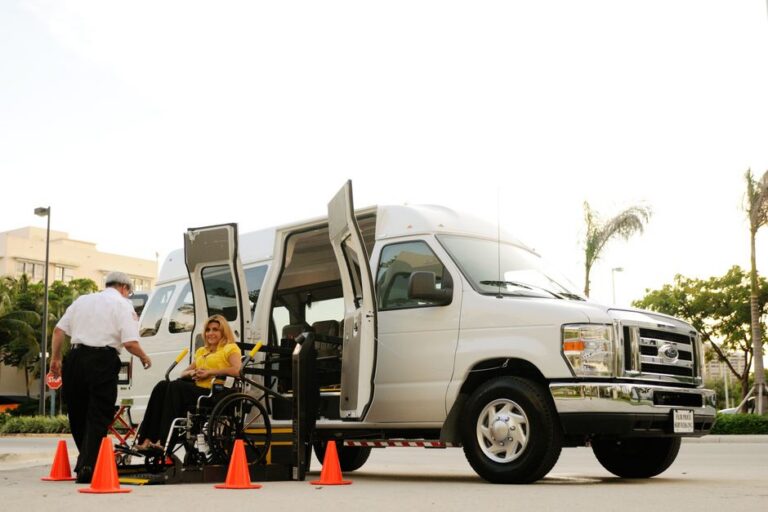
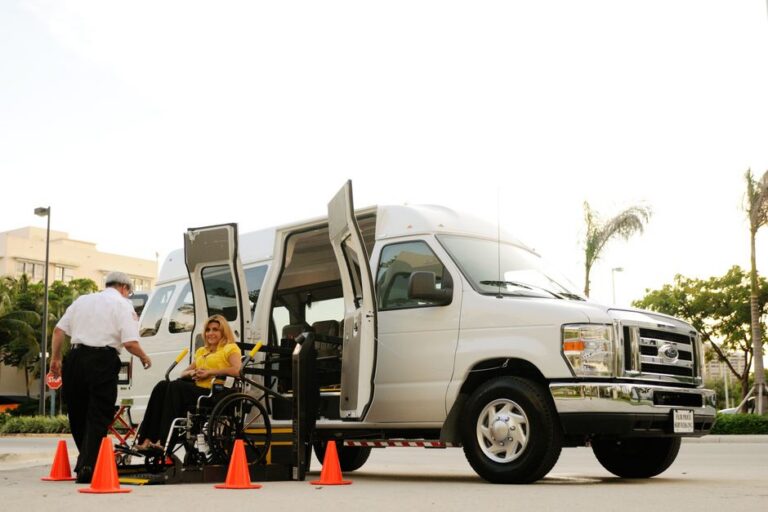
Past about two feet of rise, a vertical platform lift usually takes less room and often less money than a compliant ramp. It needs a level pad rather than fifty feet of run.
The Bruno VPL-3100 and the Harmar Highlander II both carry 750 lb, which covers a power chair and its occupant with room to spare.
This is the single most useful thing we tell people about ramps: run the numbers first, because the answer is often not a ramp.
Does a residence have to meet ADA?
A private home is not a place of public accommodation, so ADA does not require your ramp to meet the standard. We build to it anyway unless you ask otherwise, for a simple reason: a steeper ramp is harder to push up and genuinely dangerous to come down, and the person using it is the one who pays for the shortcut.
Commercial and public buildings are a different matter, and there the standard is the requirement.
Modular or permanent?
Modular aluminum installs quickly and comes back out. Permanent construction can be finished to match the house. The right answer depends mostly on how long you need it.
The Access Board also publishes a guide to elevators and platform lifts, which covers when a lift may be used in place of a ramp.
Width, handrails and edges
Slope gets all the attention, but three other numbers decide whether a ramp is usable. Clear width of at least 36 inches between handrails. Handrails on both sides where the rise is more than six inches. And edge protection, either a curb of at least two inches or a surface extending beyond the handrail, so a caster cannot drop off the side.
That last one is the most commonly skipped item on a home-built ramp, and it is the one that causes the accident.
Materials, honestly compared
Modular aluminum. Installs in a day, comes apart, and can be reconfigured if the rise changes. It looks like what it is. For most homes this is the right answer.
Poured concrete. Permanent, can be finished to match the property, and adds more to a future sale than anything modular will. Slower and more expensive.
Timber. Blends into a deck nicely and is the one that needs maintenance. Wet timber is slippery, so the surface treatment matters more than people expect.
Threshold ramps, which are a different thing entirely
If your problem is a single step at a door, or a raised threshold that catches a wheel, you do not need a ramp in the sense above. You need a threshold ramp, which is a small moulded or aluminum wedge that sits at the door.
Those cost very little and you can order them today from our shop with free shipping. We would rather tell you that than send somebody out to quote a construction project for a two-inch problem.
Permits
Permanent ramps often need one, and commercial work almost always does. We handle it, and we will tell you at the quote if one applies rather than discovering it halfway through.