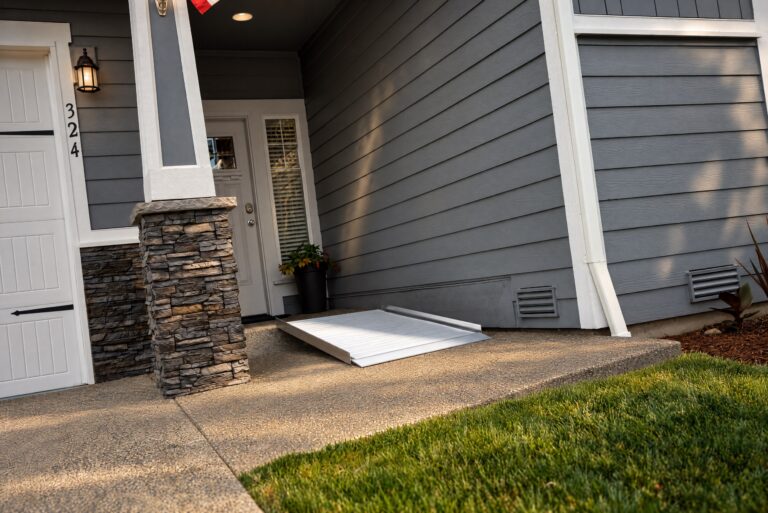
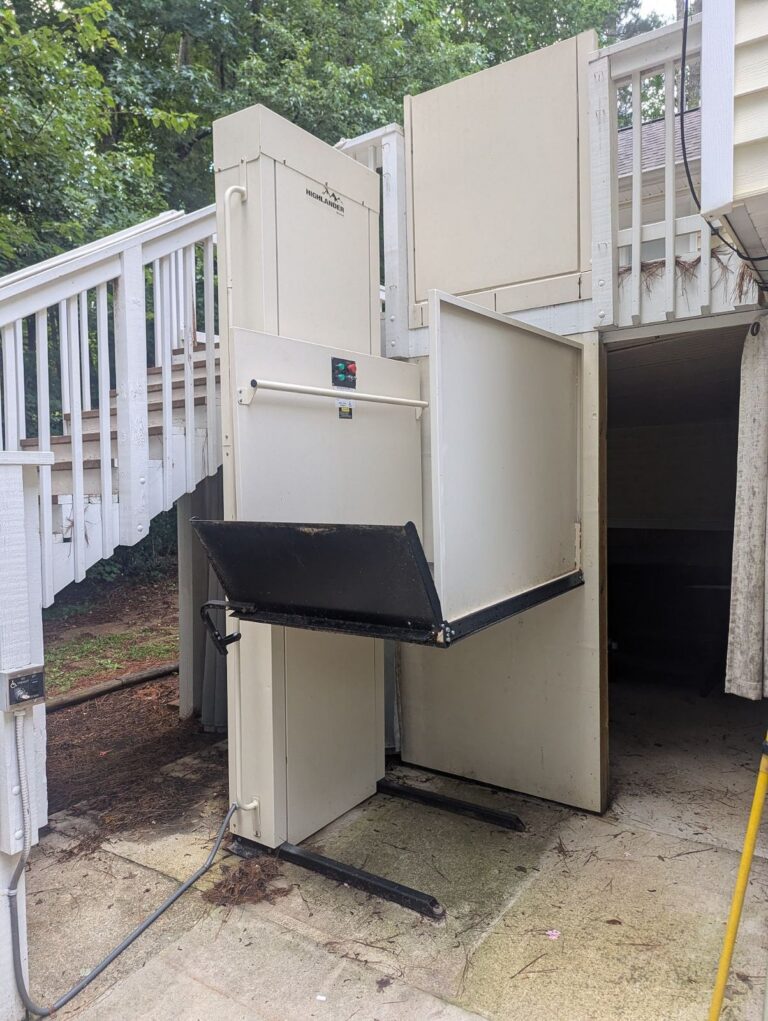
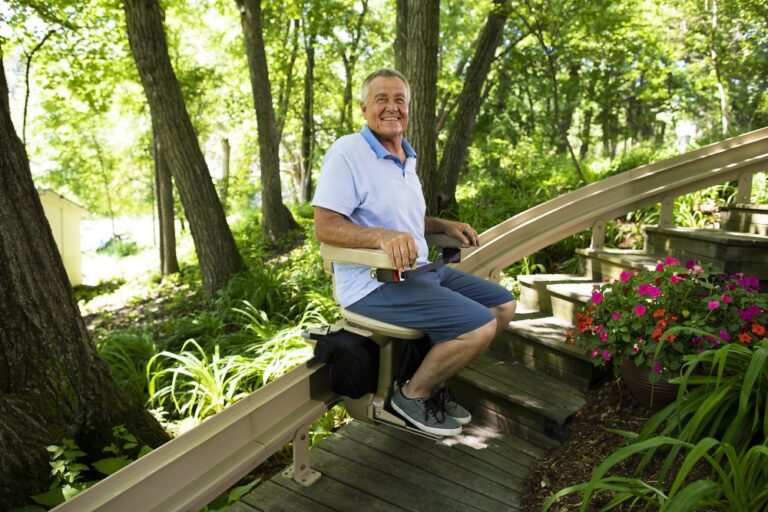
There is a category of equipment that most people have never seen: a set of steps that folds flat into a platform and travels vertically.
It exists to solve one specific problem, and where you have that problem it is frequently the only good answer.
The problem it solves
A short rise, usually a few steps, where both walkers and wheelchair users need access, and where there is not room for both a staircase and a ramp or a separate lift.
Think a raised entrance to a small shop, a chancel in a church, a split level in a house, or a stage. Somewhere you cannot lose the steps, because most people use them, and cannot fit a compliant ramp, because the run required does not exist.
How it works
In its resting state it is a normal short flight of steps. When a wheelchair user needs it, the treads fold into a flat platform which then rises and lowers on a vertical mechanism.
The mechanism is broadly that of a vertical platform lift, with the step arrangement folded on top of it.
Where it is genuinely the right answer
- Space that will not take a ramp. At 1:12 per the Access Board, a three-foot rise wants 36 feet of run plus landings. Most entrances cannot give that.
- Where the steps must remain, because everybody else uses them and there is no alternative route.
- Historic or constrained buildings where a separate structure cannot be added.
- Where a separate accessible entrance would mean sending somebody round the back, which is the outcome worth avoiding.
That last point is the strongest argument for this equipment. Everybody uses the same entrance, which is the difference between accessible and usable that our design guide sets out.
Where it is the wrong answer
A tall rise. These are short-rise devices. Beyond a few feet you are looking at a conventional platform lift or an elevator.
A private house with room for a ramp. A ramp costs a fraction, has no service contract and no inspection regime, and never breaks down.
Heavy public traffic. Converting from steps to platform takes time and the steps are unavailable while it does.
Anywhere the budget cannot carry the running costs. This is a lift, with the annual service, inspection and certification that implies in most jurisdictions.
Questions to ask before quoting
- What is the maximum rise, and what is mine?
- What is the rated capacity, and does it cover a power chair plus occupant?
- How long does the conversion from steps to platform take?
- Can it be operated unaided by the person using it, or is assistance needed?
- What inspection regime applies here, and who arranges it?
- What happens in a power failure, and can somebody be brought down?
- What foundation or pad does it need?
That fourth question decides whether it delivers independence or supervision, and it is the one most often unasked.
Indoor and outdoor
Both exist, and outdoor units need the same weather-rated construction as any outdoor lift: sealed controls, corrosion-resistant fixings, drainage designed in. A cover and a shorter service interval follow.
Our troubleshooting guide covers what goes wrong with vertical mechanisms and most of it applies here.
The honest comparison
Against a ramp: this wins on space and loses on cost, simplicity and running expense.
Against a standard platform lift: this wins where the steps must stay and where a separate lift position is not available, and loses on price.
Against doing nothing: there is no contest, and plenty of buildings sit at doing nothing because the ramp does not fit and nobody knew this category existed.
Getting a real answer
Measure the rise from the lower level to the upper, photograph the steps from a few feet back, and note how much flat space sits at the bottom.
Those three things let a supplier tell you whether a ramp, a platform lift, or a combined unit is the sensible answer before anybody visits. Our cost guide covers what moves each number.
All consultations, estimates and scopes of work are free of charge with no pressure or obligation, and smaller equipment ships free from our online shop.
Who operates it, and how that decides the choice
The question that separates a good installation from a frustrating one.
If the person using it can convert the steps and ride the platform unaided, it delivers genuine independence. If conversion requires staff, a key, or somebody who knows the sequence, it delivers access with a phone call attached.
Ask to see somebody do it start to finish before specifying. Then ask how long it takes, because a conversion measured in a minute behaves very differently at a busy entrance from one measured in seconds.
Signage and knowing it exists
A set of steps that is secretly a lift is invisible to somebody who needs it. Clear signage at the approach, and at the main entrance if the unit is elsewhere, is the cheapest part of the project and the one most often left off.
Name a contact on the sign where operation needs assistance.
Running costs
Annual service at minimum, and in most jurisdictions an inspection and an operating certificate because this is a lift rather than a staircase.
Get the annual figure in the original proposal rather than meeting it in year two, which is the mistake small organizations make most. Our commercial guide covers the duty and inspection differences.
In a home
Less common and occasionally right. A split-level house where the steps are used by the household and a wheelchair user needs the same route is the case.
Against a ramp it wins only where the ramp genuinely will not fit. Against relocating to one floor it rarely wins on cost, and our accessibility guide covers that option.
Power failure
Ask what happens, because this is both a staircase and a lift. In the step configuration a power cut is irrelevant; mid-conversion or with the platform raised it is not. Confirm there is a manual lowering procedure, that somebody on site knows it, and whether the steps can be restored without power.
Comparing it properly
Price three options on the same entrance: a ramp if the run exists, a conventional platform lift beside the steps, and a combined unit. The Access Board slope requirement frequently rules the first out in two minutes.
Then compare running costs over ten years rather than purchase price, because a ramp has almost none. Our cost guide covers what moves each number, and smaller equipment ships free from our online shop.
Who to ask
This is a less common category and not every supplier carries or installs it. Ask specifically whether a company has fitted one before, and ask to speak to somebody who has.
Our vetting guide covers the questions that apply, and they matter more than usual for equipment a supplier may be fitting for the first time.
Capacity has to cover a power chair and its occupant together. Both the Bruno VPL-3100 and the Harmar Highlander II are rated at 750 lb, which is the figure to compare any short-rise unit against.