We wrote the stairlift version of this and never the platform lift one. Here it is.
A vertical platform lift stops for fewer reasons than people assume, and the common ones are checkable without tools.
1. Are all the gates and doors fully closed?
Start here, because it is the answer most often.
Platform lifts have interlocks on every gate and landing door, and the lift will not move unless each is properly closed and latched. A gate that looks shut but has not engaged its latch stops the lift completely.
Open and close each one firmly. Listen for the latch. Check the upper landing gate as well as the lower one, because people forget it exists.
2. Is something under the platform?
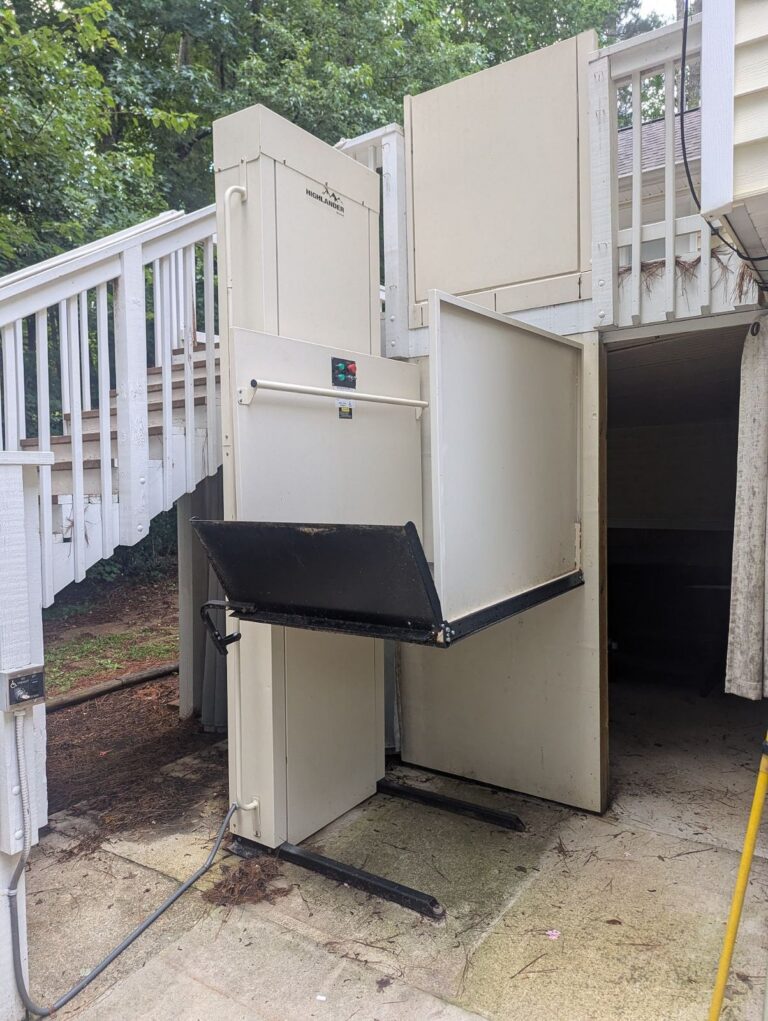
Underpan sensors stop the lift if anything is beneath it. Leaves, a stone, a toy, an animal, or a build-up of debris in an outdoor pit.
Look underneath. On outdoor installations this is the commonest seasonal fault, and clearing it is the whole repair.
3. Is the platform obstructed at the edges?
Rollstops and edge sensors also stop travel. A bag against a barrier arm, a coat caught, or a rollstop that has not fully folded.
4. Is it on constant pressure?
Residential platform lifts move only while a control is held. Release the button and it stops.
Somebody unfamiliar with the lift frequently presses and releases, concludes it is broken, and calls. Hold the control continuously and see whether it travels.
5. Power and the emergency stop
Check the outlet, the breaker, and any isolator switch. Then check the emergency stop button has not been left pressed in, which happens more than you would think in a public building.
Twist or pull it out per the model and try again.
6. Battery and charging
Many platform lifts run on batteries charged from the mains, which is how they keep working in an outage. As with stairlifts, batteries are the commonest consumable and they degrade quietly.
If the lift is slow, hesitant or travels only part way under load, suspect the batteries before anything else.
7. The key switch
Where fitted, usually in public or semi-public installations. It gets turned and forgotten, and the sign next to the lift rarely says who holds the key.
What to stop doing
Do not defeat an interlock. Ever. They exist so the platform cannot move with a gate open and so a gate cannot open onto a shaft with no platform behind it. Anybody suggesting a workaround is suggesting something genuinely dangerous.
Do not keep cycling it if it is straining or the motor is labouring.
Do not lubricate anything unless the manual specifically calls for it.
Call immediately if
- Somebody is on the platform and it has stopped. Use the manual lowering procedure, which should have been demonstrated at handover.
- A gate can be opened while the platform is not at that landing.
- The lift moves when the control is released.
- There is visible hydraulic fluid.
- The platform is not level.
Those are safety items rather than maintenance items.
What to have ready when you call
Make, model, serial number, what it was doing, what it does now, any fault indication, and whether it is intermittent. Photographs help.
For a commercial installation, also have the maintenance log and the date of the last inspection to hand.
Outdoor lifts and the seasons
Most of the faults above are more common outdoors. Debris under the platform, water in the pit, insects in control housings, and corrosion at connectors.
Keep the pit clear, use the cover, and service twice yearly rather than annually. Our platform lift guide covers the equipment and our outdoor guide covers the wider weather picture.
In a public building
Inspection and certification requirements apply in most jurisdictions, and a lift out of service may be the only accessible route into the building.
Have a plan for that day: who is called, what the response time is, and what happens to access meanwhile. The Access Board covers when a platform lift may serve as part of an accessible route, and our commercial guide covers the duty and inspection differences.
Smaller equipment ships free from our online shop.
The manual lowering procedure
Ask to be shown it at handover, and ask again at the first service, because it is the thing nobody remembers and the thing that matters when somebody is stuck.
On most hydraulic platform lifts it is a valve that releases fluid in a controlled way, bringing the platform down slowly without power. Know where it is, what it looks like, and who in the household or the building can operate it.
Photograph it and keep the photograph with the manual.
Seasonal checks worth doing
- Clear the pit and the area under the platform.
- Check drainage is running rather than pooling.
- Look inside control housings for nests and insects.
- Check the gate latches engage firmly rather than nearly.
- Run the lift the full travel and listen for changes.
- Check the cover is intact where one is used.
Fifteen minutes twice a year, and it prevents most of what we get called out to on outdoor units.
Keeping a log
In a commercial or public installation a maintenance log may be a legal requirement rather than good practice, and it is the document an inspector asks for.
Even at home it is worth keeping: dates, faults, what was found, what was replaced. A pattern across two years tells a technician more than any single visit.
Who to call
We service equipment we did not install, including where the original company has gone out of business, subject to parts availability for that platform. Tell us the make and model and we will say honestly before you book anything.
What we charge to look
Ask any company before booking. A call-out fee credited against the repair is normal; one charged on top of a repair is worth knowing in advance. We will also say on the phone when we cannot support a platform rather than discovering it on site.
Preventing most of it
Keep the pit and underside clear. Close gates firmly. Park where it charges. Service annually indoors, twice yearly outdoors. Keep a log.
The Access Board sets out when a platform lift serves as part of an accessible route, which is what makes downtime a real problem in a public building. Our platform lift guide covers the equipment, and smaller items ship free from our online shop.
Teach somebody else
In a household or a building, at least two people should know the six checks above and the manual lowering procedure. A lift that stops when the only person who understands it is away is a lift out of service.
Print the checks and keep them with the manual, near the lift rather than in a drawer upstairs.
Batteries are the commonest consumable across this equipment. Harmar publishes up to 60 trips on batteries during an outage for its heavy-duty stairlift, and the same principle applies to a platform lift kept properly charged.